
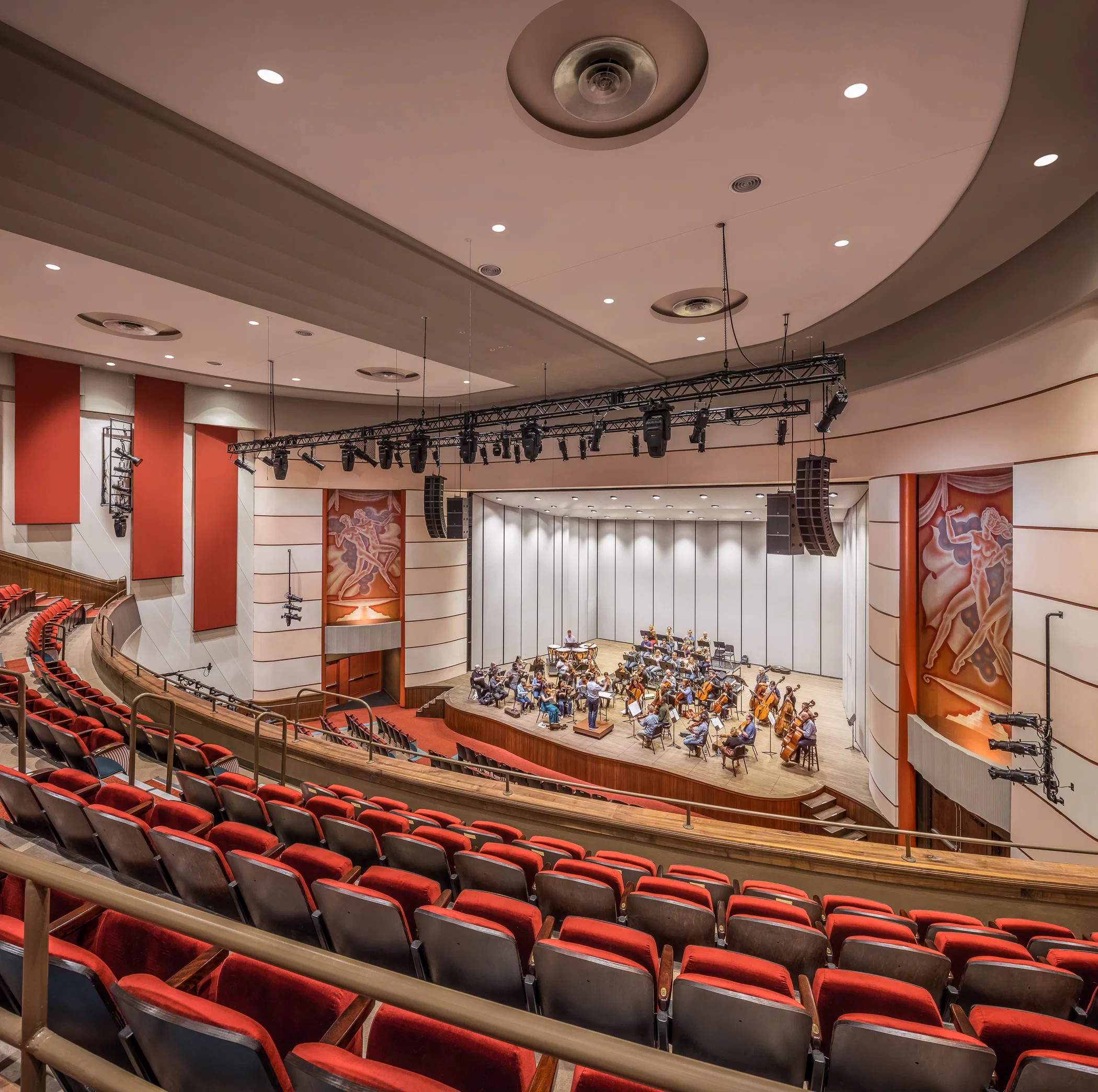
This venue changes the brief because it has an audience orientation built into it. The room wants a stage, a focal program, and a stronger sense of show timing than a banquet hall or social venue does.
That makes the section about performance format and audience attention, not about flexible mingling or private-event hospitality.
Verified venue facts
- The Miller's official rentals section says the theater offers Brian J. Marks Hall, the Founders Room, and the KMI Loft under one roof, with capacity for up to 144 seated dinner guests, 500 standing reception guests, or nearly 1,300 seated in the main hall.
- The same section says full buyouts using all three spaces can host up to 2,000 people and that packages start at $2,500 including house sound, lighting, tables, chairs, and linens.
- The official Founders Room and Knox Music Institute sections position the side venues for small gatherings, meetings, receptions, and private events with built-in bar, projection, and loft-style features.
Execution priorities
- Plan the event like a performance experience, not an open reception.
- Use stage, cueing, and audience sightlines as core decisions.
- Respect the room’s fixed seating and theater behavior.
- Treat Miller as an attention-forward venue, not a casual social space.
Miller Theater at a glance
The theater offers Brian J.
Full buyouts using all three spaces can host up to 2,000 people and that packages start at $2,500 including house sound, lighting, tables, chairs, and linens.
Located at Downtown Augusta Theater District.
Projects at Miller Theater start with its published floor plan, dock schedule, and service-order deadlines.
Augusta trade show market
Scope gets tighter; standards don't.
AGS is served by Delta to Atlanta and American to Charlotte, Dallas, and Washington, D.C., and that the airport sits about six miles south of Augusta's central business district — a useful reference point when sizing a project.
The advantage of a local Augusta team
Local fabrication means real-time problem-solving. A graphic that needs to be reprinted at 6 a.m.
Consistency across show dates is the other reason to hire local. The same crew that built the booth runs the install, knows the pack-out, and catches the small things — a missing hardware pack, a graphic edge that needs reseating, a storage crate routed to the wrong bay — without needing the client team to intervene.
Augusta labor and venue services
There is no single labor model for Augusta trade shows.
Use phrases such as 'venue-directed services', 'official exhibitor guide', 'service manual review', 'managed planning support', and 'show-contractor coordination aligned with current venue rules'. Treat Augusta as a CSRA market where downtown convention work, suburban exhibition halls, stadium hospitality, university facilities, and boutique hotels each behave differently.
What goes into a build at Miller Theater
A build at the theater carries a specific shopping list, formed by the room itself: structure, graphics, AV, show services, drayage, and the labor calls the building's rules require.
The plan stays clean when those line items track the venue's behavior, not a generic floor template; that match-up is what keeps the budget honest from kickoff through closeout.
The process from start to finish
Everything downstream hinges on those answers.
Once scope is clear, the venue work begins.
The install phase has one owner on the floor.
Strike and closeout happen the same day.
Budget and timeline
Six variables drive the cost: custom versus rental, booth footprint and complexity, venue-specific labor and rigging fees, graphics scope and substrate, freight distance and timing, and the number of on-site supervision days.
A clean schedule starts 4 to 5 months out for custom work and 2 to 3 months for rentals. Shorter lead times are workable but push rush premiums and limit material choices.
Outcomes we optimize for
Most programs in Augusta are evaluated on lead-capture volume, meetings booked on the floor, and qualified-pipeline attribution after the show. The booth is a means to those numbers — it is not the number itself.
Client teams sometimes want the booth to carry the pipeline on its own, but the best-performing programs treat the booth as a platform and put real operators on it. On-floor conversation discipline moves the KPIs more than any scenic decision.
Miller Theater questions
How does labor and crew time work at Miller Theater?
It runs against the building's published rules and the show's exhibitor manual. At the theater, crew is sized to the room, the load-in window, and whatever the venue's house team is already covering.
How far ahead should we book this work?
The further out the better, because the building's calendar fills against its own holds. For the theater, locking the date earlier protects the parts of the program that depend on the venue's behavior.
What information is needed to start a project at the program?
Confirmed dates, the program brief, expected headcount, and the parts of the room being used. From there, the buildout plan can match what the theater actually offers.
Who runs the room on-site at this service?
One named field lead carries the schedule, the punch list, and the venue contact at the theater. That role is the single source of truth from install through strike.
Can a build at the plan pack out and travel to the next city?
Most of the time, yes.
What happens if something breaks during show hours at this work?
The on-site lead handles it.